

Welcome to NEWBotics Labs (NorthEast Wisconsin roBotics Labs)
We hope you enjoy your visit here. Please join or login if you have joined before.
News
 …
…

 …
…I love you, robot!

- Posted 2nd April 2017, 12:00 PM
-
By Jason

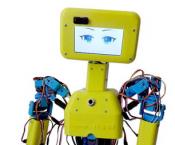
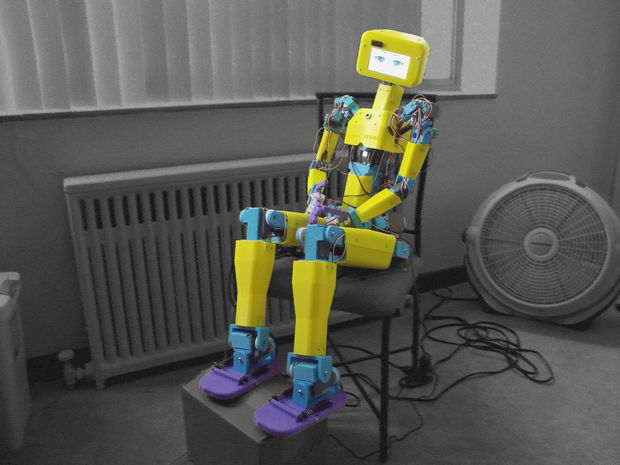
I love you, robot! It doesn't get much cuter than this.
https://youtu.be/h1E-FlguwGw
- Read more 0 comments
Older news
News from: Robotics News - Robot News, Robotics, Robots, Robotics Sciences
Swapping batteries for hydrogen gives drones a whole new range
Researchers have built a drone that runs on hydrogen, to replace battery-powered drones that are too heavy and have too short a range. This technology could help fix power outages faster and replace dangerous helicopter missions with the new drones.
Sheepdogs reveal a better way to guide robot swarms
Sheepdogs, bred to control large groups of sheep in open fields, have demonstrated their skills in competitions dating back to the 1870s. In these contests, a handler directs a trained dog with whistle signals to guide a small group of sheep across a field and sometimes split the flock cleanly into two groups. But sheep do not always cooperate.
Compostable robot endures over 1 million uses before becoming plant…
The rapid proliferation of robots and electronic devices is placing the world under a new and growing environmental burden. According to the United Nations Institute for Training and Research (UNITAR), global electronic waste (e-waste) reached approximately 62 million metric tons in 2022, a significant portion of which was neither properly collected nor recycled but instead landfilled or incinerated.
Autonomous navigation of microrobots in complex flows demonstrated…
For the first time, researchers at Leipzig University have shown that tiny synthetic microswimmers can perceive their surroundings directly through their own body shape and autonomously adapt to rapidly changing fluid flows. The study, now published in Science Advances, establishes a new paradigm for autonomous microsystems whose control functions reliably in challenging environments where conventional sensors fail. This opens up new prospects for autonomous medical microrobots, for example for the targeted delivery of medication in the bloodstream.
Thermal cameras used in drones and robots can be tricked by heat so…
As thermal cameras become commonplace on autonomous drones and vehicles, a University of Florida engineering professor is working to make sure they can't be maliciously tricked into "seeing" things that aren't there.
4D printing technology uses waste sulfur to enable self-actuating s…
A joint research team led by Dr. Dong-Gyun Kim of the Korea Research Institute of Chemical Technology (KRICT), Professor Jeong Jae Wie of Hanyang University, and Professor Yong Seok Kim of Sejong University report the world's first 4D printing technology based on sulfur-rich polymers that respond to heat, light, and magnetic fields. The study was published in Advanced Materials.
New chip lets robots see in 4D by tracking distance and speed simul…
Current vision systems for robots and drones rely on 3D sensors that, although powerful, do not always keep up with the fast-paced, unpredictable movement of the real world. These systems often struggle to measure speed instantly or are too bulky and expensive for everyday use. Now, in a paper published in the journal Nature, scientists report how they have developed a 4D imaging sensor on a chip that creates 3D maps of an environment while simultaneously tracking the speed of moving objects.
Canine companion insights help robots locate objects with an 89% su…
Whether in the kitchen or on a workshop floor, robot assistants that can fetch items for people could be extremely useful. Now, a team of Brown University researchers has developed a way of making robots better at figuring out exactly which items a user might want them to retrieve.
AI search robot uses 3D maps and internet knowledge to find lost items
A robot that can locate lost items on command, the latest development at the Technical University of Munich (TUM), combines knowledge from the internet with a spatial map of its surroundings to efficiently find the objects being sought. The new robot from Prof. Angela Schoellig's TUM Learning Systems and Robotics Lab looks like a broomstick on wheels with a camera mounted at the top. It is one of the first robots that not only integrates image understanding but also applies it to a clearly defined task.
Robots that learn everyday tasks can free humans from repetitive work
A robot task AI capable of learning and performing everyday repetitive tasks in a human-like manner has been developed. The AI learns tasks through human demonstrations and executes complex tasks step by step based on a hierarchical task execution framework. The technology is expected to contribute to the automation of labor-intensive repetitive work and reduce human workload in homes, offices, as well as retail and logistics environments.